
To estimate a small-business chatbot project’s cost, separate one-time setup from recurring platform, usage, hosting, integration, and maintenance costs. Then price the actual workflow: a public FAQ assistant is a different project from an assistant that accesses private records or creates confirmed bookings.
There is no single reliable price for “a chatbot” without a scope. A useful estimate states assumptions, identifies what is included, and shows how the total changes with usage or additional actions.
1. Define the smallest useful scope
Write the audience, main task, source documents, website or channel, and human follow-up route. Decide whether the assistant only answers questions or also performs actions. List the systems it must connect to and the people who approve its information.
A small FAQ assistant may need source cleanup, configuration, a website embed, and testing. A booking assistant may also need calendar authorization, live availability, confirmation handling, and failure recovery. An internal assistant adds identity and document-access requirements. These differences drive work even when the chat interface looks similar.
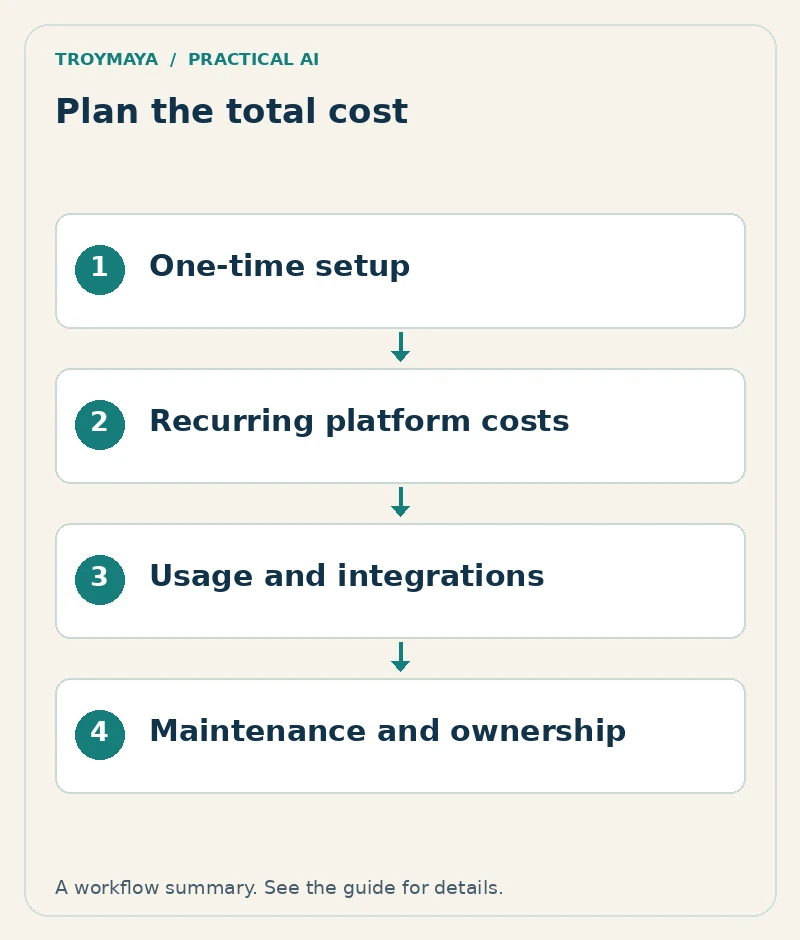
2. Separate five cost categories
| Category | What to ask about |
|---|---|
| Initial setup | Discovery, source preparation, configuration, integration, tests, and handover. |
| Platform and hosting | Subscription, hosting, storage, and included allowances. |
| Usage | What is metered, included limits, overages, and spending controls. |
| Connected systems | Calendar, email, automation, CRM, or other required services. |
| Maintenance | Source updates, monitoring, fixes, and responsibility for changes. |
Check current vendor terms before committing. Do not assume that a low advertised plan includes every integration, channel, or team feature. Keep the estimate’s date and the plan assumptions so it can be reviewed later.
3. Calculate a first-year planning total
The following figures are invented solely to demonstrate the calculation. They are not market averages, vendor prices, or a TroyMaya quote.
Hypothetical setup:                 $1,500
Hypothetical monthly platform:        $60
Hypothetical monthly usage allowance: $25
Hypothetical monthly maintenance:     $90
Hypothetical monthly integration:     $15

Monthly planning total:
60 + 25 + 90 + 15 = $190

First-year planning total:
1,500 + (12 × 190) = $3,780
This example excludes taxes and any additional work outside the assumed scope. Replace every figure with an actual proposal or verified provider amount. If the platform already includes usage or hosting, do not count the same cost again in another row.
4. Test a low, expected, and busy usage scenario
Use the provider’s actual billing unit: messages, conversations, tokens, credits, or another measure. These are not interchangeable. A long conversation or a workflow that calls several tools can consume more resources than one short answer.
Ask what happens when an allowance is exhausted. Does the assistant stop, charge an overage, or fall back to a contact route? Set an operational budget and monitoring process where the platform supports them. Avoid estimating usage only from total website visits; not every visitor opens the chat, and not every chat has the same length.
5. Compare proposals using the same assumptions
Check whether both proposals include source cleanup, mobile checks, action tests, staff training, and handover. Ask who owns the accounts and source files and how you can export or replace the system. A cheaper setup can become expensive if routine changes require rebuilding the assistant.
Also ask what counts as a new feature. Updating a published business hour is different from adding authenticated order lookup. A clear maintenance boundary helps both the client and developer plan the work.
6. Relate the budget to a measurable business task
Choose an outcome such as complete inquiries, confirmed bookings, or time spent answering repetitive questions. Establish a baseline where possible. Do not assume every chat becomes a sale or treat hypothetical saved hours as realized revenue.
Want a scoped estimate for your project?
Discuss your chatbot with TroyMaya. Send the main task, website, source types, required integrations, target date, and budget range. The AI services page explains available work; project scope and pricing are assessed individually.
Prepared with AI assistance. Examples are illustrative unless stated otherwise.