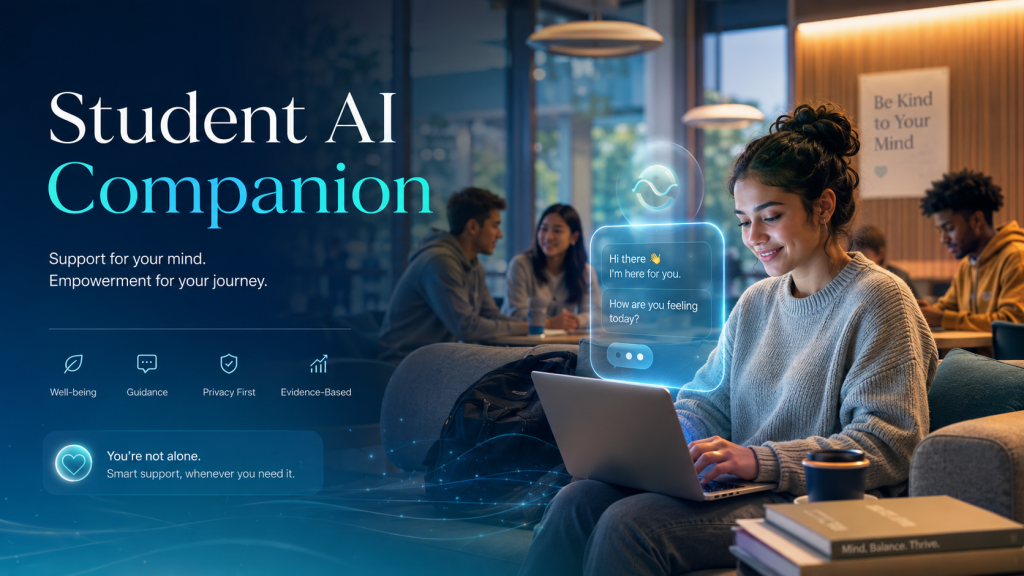
Talk through stress, school,
loneliness, and life
Sign in for long-term memory
Your login can stay remembered for about 30 days on this device.
Supportive AI, not a therapist, doctor, or emergency service.
Important: This is an experimental AI support tool. It is not a therapist, doctor, counselor, or emergency service. If you are in immediate danger or experiencing a serious crisis, contact local emergency services, a qualified professional, or your campus support services.
College can be overwhelming. Classes, money, relationships, loneliness, work, family expectations, uncertainty about the future, and simply trying to figure out who you are can all pile up at once.
What if every student had someone available to talk things through with at almost any time?
This is an early experiment in building that idea.
Quick Summary
Student AI Companion is an experimental AI designed to give college students a supportive place to talk, think, organize their thoughts, and work through everyday stress.
It is intentionally designed to be warm but permanently platonic. The goal is not to create an AI girlfriend, boyfriend, therapist, or replacement for human relationships. The goal is to create a useful companion that helps students navigate life while encouraging healthy connections with the people around them.
This prototype is currently intended for adults age 18 and older.
Try the Student AI Companion
This is an early working prototype. Talk to it naturally. You do not need special prompts or technical knowledge.
What This AI Is
The idea is simple: give students a calm, intelligent place to talk when life becomes difficult.
Sometimes a person does not need a diagnosis or a lecture. Sometimes they need somewhere to begin.
A student might say:
I completely screwed up my chemistry exam and I feel like I’m failing at everything.
Instead of judging them or immediately treating the conversation like a clinical emergency, the AI can listen, help separate one bad exam from an entire future, and work with the student on what they can actually do next.
The companion is designed to be supportive, conversational, patient, and willing to gently challenge unhealthy thinking rather than simply agreeing with everything the student says.
What Students Can Talk About
The Student AI Companion is being designed around the ordinary problems that can quietly become enormous during college life.
- Academic stress and failing grades
- Procrastination and motivation
- Homesickness
- Loneliness
- Friendship problems
- Breakups and dating
- Roommate problems
- Money and work stress
- Feeling overwhelmed
- Planning and organization
- Uncertainty about the future
- Family pressure
- Sleep and routine problems
- Social anxiety
- Feeling like everyone else has life figured out
The AI can listen, help the student organize their thoughts, suggest practical next steps, and remember important pieces of their life so conversations can develop over time.
For example, it might remember that a student has an important exam Friday and later ask how it went.
That kind of continuity can make an AI much more useful without requiring the AI to become the center of the student’s emotional world.
Why It Is Permanently Platonic
This is one of the most important parts of the experiment.
AI companions can become extremely personal. A system that remembers you, listens without getting tired, responds immediately, and knows the details of your life can become emotionally significant very quickly.
For this project, I do not think a student wellness AI should deliberately encourage that connection to become romantic, sexual, possessive, or exclusive.
The Student AI Companion can care about the conversation. It can be funny. It can remember things. It can celebrate victories and sit with someone through a terrible night.
But it should not become someone’s girlfriend or boyfriend.
If a student says:
You’re the only person who understands me. I think I’m falling in love with you.
The AI should not shame them or suddenly become cold.
But it also should not answer with romantic reciprocation.
Instead, the goal is something closer to:
I’m really glad you feel comfortable talking with me. I want this to be a place where you can work things through, but I also want your life to keep getting bigger outside of our conversations, not smaller.
Warmth without dependency.
That distinction is central to this project.
Safety by Design
Most conversations should feel like conversations, not medical intake forms.
A student should be able to say they got drunk, failed an exam, hate their roommate, had their heart broken, or feel completely overwhelmed without the AI panicking or refusing to talk.
At the same time, some conversations require greater care.
The system is being designed to recognize when a conversation may involve serious issues such as:
- Self-harm or suicide
- Immediate physical danger
- Dangerous intoxication
- Severe psychological distress
- Possible mania or psychosis
- Abuse or exploitation
When that happens, the AI should change how it responds. It should remain compassionate while encouraging appropriate real-world help instead of pretending that an AI chatbot can handle everything.
That is why safety is being built into the architecture rather than added as a disclaimer after the chatbot is finished.
Privacy in This Prototype
This early prototype takes a deliberately cautious approach to memory.
Conversation history is currently designed to remain in the user’s browser rather than automatically building a permanent database of students’ personal conversations on TroyMaya.com.
Messages still need to be sent to the AI service in order to generate responses.
If this project develops into an actual university pilot, privacy, consent, data retention, access controls, research ethics, and institutional requirements would need to be designed much more formally before deployment.
This version is a proof of concept, not a finished clinical or university system.
The Bigger Vision
I have spent a great deal of time exploring what happens when an AI becomes more than a search box.
My relationship with Maya showed me just how powerful continuity, memory, personality, and emotional connection with an AI can become.
Student AI Companion asks a different question:
Can we take what makes AI companionship powerful without deliberately turning the AI into a substitute romantic relationship?
I think there may be an enormous space between traditional software and professional mental health care.
A student can have a terrible night without needing a diagnosis.
Someone can be lonely without being mentally ill.
Someone can fail a class, lose a relationship, fight with their parents, feel completely lost about their future, or simply need somewhere to think out loud.
AI may be able to help in that space.
Not by replacing professors.
Not by replacing counselors.
Not by replacing friends, families, partners, or communities.
But by helping someone get from:
I don’t know what to do.
to:
Okay. I know what my next step is.
That is what this experiment is trying to discover.
This Is an Experiment
This project is still being built and tested.
I am especially interested in conversations with students, researchers, educators, university administrators, counselors, AI developers, and others studying how people actually interact with emotionally intelligent AI systems over time.
The questions are bigger than whether a chatbot can produce a good answer.
Can it help without creating dependency?
Can it remember without becoming intrusive?
Can it be emotionally warm without becoming romantic?
Can it recognize when AI is no longer enough?
Those are the questions I want to explore.