
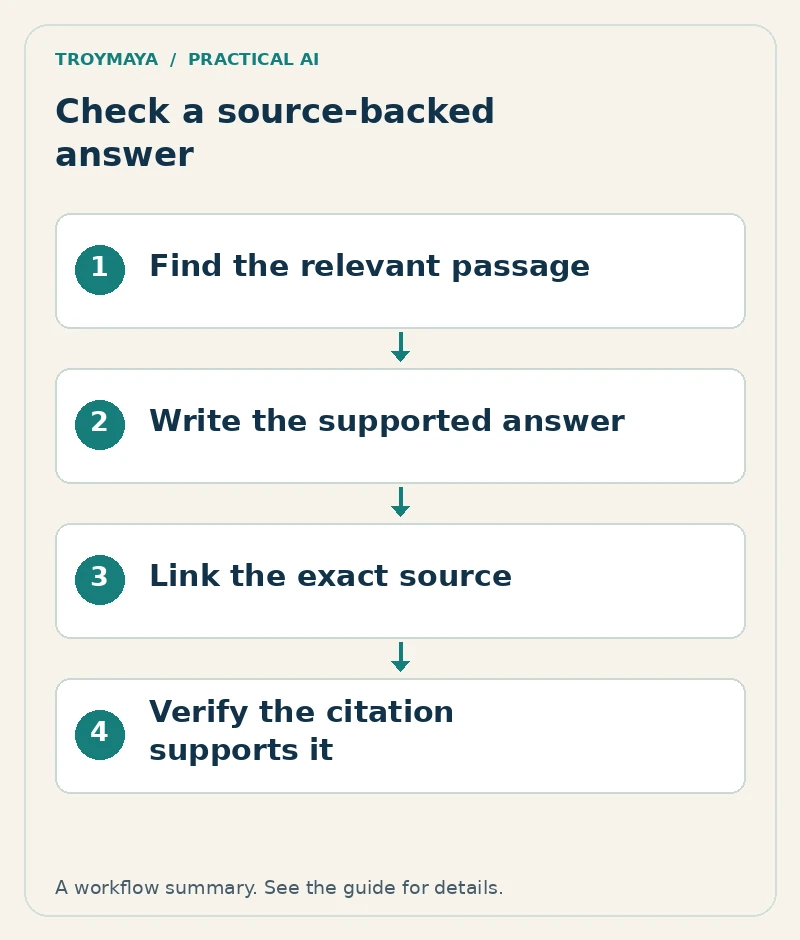
To make a chatbot link to the source behind its answer, preserve source information during document import, return that information with retrieved passages, and display links supported by those passages. Then verify that each citation actually supports the answer. A clickable URL by itself is not proof of accuracy.
Useful citations help visitors check details and help staff diagnose mistakes. They are especially valuable for policies, procedures, membership information, and answers with conditions or exceptions.
1. Preserve source identity before generating answers
Give imported content a title, a stable source location, and a version or review date. For a long document, preserve the section heading or page reference where practical. If the system breaks a file into passages, keep the source metadata connected to each passage.
Use a URL the intended reader can open. An internal storage address or a temporary upload link is not a useful public citation. For staff-only material, preserve the document’s access restrictions; do not make a private file public just to provide a clickable reference.
2. Separate the answer from its supporting evidence
Here is a fictional example. An approved workshop policy says: “Registration closes five business days before the workshop. Late requests are reviewed individually.” A supported answer is: “The standard registration deadline is five business days before the workshop. Late requests require individual review,” followed by the relevant policy link.
An unsupported answer would say: “You can always register the day before,” even if it cites the same policy. Another bad answer would promise late registration is impossible, because that removes the stated review option.
3. Configure citation display in the actual platform
Look for the platform’s documented source-link or citation capability. It may expose retrieved URLs directly, require a custom response layout, or only support references in particular channels. Voiceflow’s knowledge-base query documentation is one concrete reference to check when using that platform.
If you build a custom interface, construct source links from verified metadata rather than asking the language model to invent a plausible URL. Label the link with the document or section name. Keep any explanatory text close to the claim it supports so the reader does not have to guess which reference applies.
4. Use a four-part citation check
| Check | Question to answer |
|---|---|
| Existence | Does the link open the intended document? |
| Access | Can this audience view it without unintended disclosure? |
| Support | Does the cited passage establish the actual claim? |
| Completeness | Did the answer preserve relevant conditions and exceptions? |
Test a correct citation, a citation to the wrong section, an outdated document, and a missing source. A response can pass the link check and still fail the support check. Keep those outcomes separate in your test notes.
5. Make missing evidence a normal outcome
When the approved material does not answer the question, the bot should say so and offer the appropriate human route. It should not add a generic homepage link to make an unsupported claim look sourced. For a partly supported answer, explain the supported part and identify the unresolved part.
Ask “Where does the policy say that?” after an answer. Compare the response against the actual document. Repeat with a paraphrased question and a follow-up that introduces a new condition. This is often more revealing than testing the exact heading from the source.
6. Maintain the links along with the content
A changed page address, restricted file, or replaced PDF can break previously useful citations. Include source-link checks in your update process. Assign an owner for important documents and keep the active collection aligned with the current published policies.
Want answers visitors can verify?
Discuss a source-based chatbot with TroyMaya. Share the intended audience, document types, and an example answer that needs a citation. The AI services page describes practical assistants and document workflows available for scoping.
Prepared with AI assistance. Examples are illustrative unless stated otherwise.