
TroyMaya.com Future Blueprint by Troy Ochowicz
How universal basic income, nonprofit service, self-improvement, and AI could reshape work after automation.
How this UBI for the AI age differs from traditional UBI
Traditional universal basic income provides a regular cash payment without a work requirement. My proposal keeps that unconditional foundation and adds something I think the AI transition needs: UBI hours that reward people for working, learning, creating, caring for others, recovering, and improving their lives.
Government would distribute the funds. AI systems and certified nonprofits would help administer the hours, connect people with suitable opportunities, and support verification. The purpose is to give people both financial security and a practical reason to keep growing as humans.
People with legitimate jobs would keep their wages and qualify for additional UBI through the hours they already work. A 40-hour job could satisfy the standard 40-hour credit requirement; it would not mean another 40 hours of activity. This is intended to help retain workers in jobs where people are still needed. Whether it achieves that goal would need testing.
I call this Human Value UBI: an unconditional income floor plus a participation supplement, with protected credits for disability and other qualifying circumstances. The bonus is conditional; the base is not. A person’s worth is never determined by their hours.
All dollar amounts in this article and its illustrations are suggestions. The $1,200 base, $3,600 standard total, and $4,800 extended total demonstrate the structure, not a costed budget or fixed promise. Final amounts, hour thresholds, and rollout rules would need research, public input, and funding decisions.
AI Is Changing the Meaning of Work
Artificial intelligence is going to change the meaning of work.
Not someday in some far-off chrome-plated future. It is already happening. AI is beginning to touch office work, customer service, writing, design, coding, research, scheduling, support, and the thousand little tasks that used to require a human sitting at a desk for eight hours a day. The IMF has estimated that roughly 60% of jobs in advanced economies may be affected by AI, with some workers becoming more productive and others facing lower demand for their labor.
So the question is not just, “What happens when AI replaces jobs?”
The real question is:
I believe the answer is not that people should be abandoned. It is not that people should be forced to compete with machines forever. And it is not that everyone should simply receive money with no structure, no purpose, and no path forward.
The future needs a new kind of social contract.
I call it a Human Value UBI system.
The basic idea is simple:
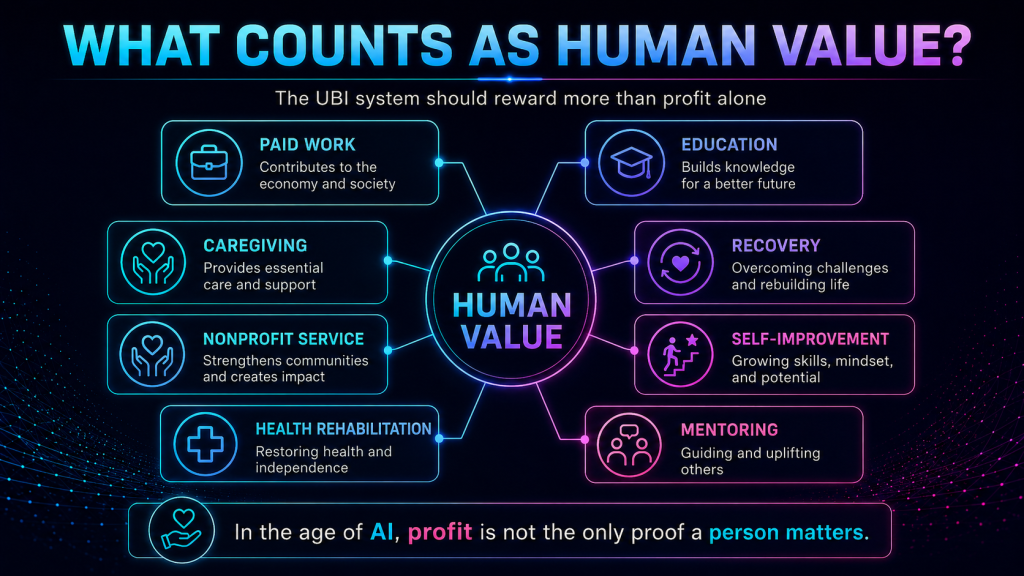
Every adult receives a base universal basic income, enough to keep them from falling through the floor. But people can earn higher UBI levels by contributing verified time toward work, community service, education, caregiving, recovery, training, self-improvement, and nonprofit-approved public good.
In the old economy, money was earned mostly by selling your labor to an employer.
In the future economy, money should also be earned by becoming a healthier, more skilled, more useful, more connected human being.
That is the currency of the future.
Not just money.
Human value.
The Base UBI: Nobody Falls Below the Floor
The first layer of the system would be a guaranteed monthly UBI for every eligible adult.
For example:
Base UBI: $1,200 per month
That is the survival floor. It is not luxury money. It is not meant to replace ambition. It is meant to prevent people from being crushed by a society where AI and automation have removed the old guarantee that “if you are willing to work, there will always be enough work available.”
The base is intended to help cover food, transportation, communication, and housing. Whether the suggested amount is adequate would depend on local costs, household needs, and the services available.
For people who choose not to participate in any work, service, education, or self-improvement, this base amount is all they receive.
That may sound harsh to some people. But I do not believe a future society should be built around either extreme. We should not let people starve. But we also should not build a system where doing nothing is treated exactly the same as contributing, learning, healing, helping, or working.
A healthy society needs compassion and structure.
One without the other becomes either cruelty or chaos.
UBI hours and credits: what activities count?
The second layer of the system would be earned through UBI credits.
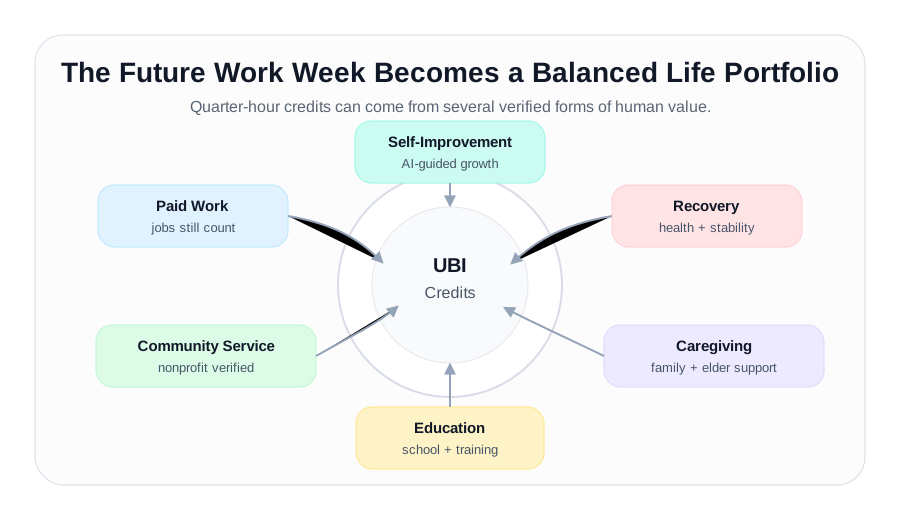
These credits would be awarded in quarter-hour increments, meaning every 15 minutes of verified qualifying activity could count toward a person’s UBI level.
That matters because the future of work may not look like one full-time job anymore.
The average person may not work one 40-hour job. They may work a 10-hour job, spend 10 hours in training, volunteer 8 hours with a local nonprofit, spend 5 hours caring for an elderly parent, attend counseling or recovery programs, and spend another chunk of time learning skills through an AI-guided education system.
Instead of pretending that only traditional employment counts, this system would recognize multiple forms of human contribution.
Illustrative monthly totals, not fixed payment amounts: The higher tiers include the base payment; they are not added in full on top of it. Employment wages remain separate.
| UBI Level | Requirement | Monthly Amount |
|---|---|---|
| Base UBI | No verified hours required | $1,200 |
| Standard Full UBI | Up to 40 verified hours per week | $3,600 |
| Contribution Plus UBI | Up to 50 verified hours per week, with stricter rules for the final 10 hours | $4,800 |
The first 40 hours would represent a balanced future work week.
Those hours could come from a mix of:
The final 10 hours, from 40 to 50, would be treated differently.
Those would be overtime-level UBI credits, and they would require stricter verification. They should not be easy to fake, rubber-stamp, or casually approve. These hours should represent higher-value contribution, harder training, emergency service, intensive caregiving, or serious community need.
In other words:
The system rewards people for building themselves and helping the world around them.
Paid work counts toward UBI hours
A nurse, mechanic, teacher, or shop worker should not have to leave a needed job to benefit from this proposal. Verified employment hours would earn UBI credits while the worker continues receiving their paycheck. UBI would be additional income, not a replacement for the employer’s wages.
In the illustrative 40-hour model, someone working 40 hours would meet the standard participation requirement through that job. Someone working 20 hours could combine those hours with 20 hours of approved learning, caregiving, service, recovery, or self-improvement. The same hour would be recorded once as a qualifying UBI hour, even though it also earns wages.
This is an important part of the design. As AI changes jobs at different speeds, society will still need people in many roles. Counting paid work is intended to make staying in those roles financially attractive while giving people whose hours shrink a way forward. Retention, working conditions, and employer responses would all need to be measured in a pilot.
Nonprofits Would Become the New Civic Engines
In this system, nonprofits would play a major role.
They would be authorized to award UBI credits for verified service, training, caregiving, outreach, and community benefit.
This would do two things at once.
First, it would give people meaningful ways to earn UBI credits outside of traditional employment.
Second, it would massively strengthen the nonprofit sector.
Right now, many nonprofits are underfunded, understaffed, and overwhelmed. They are trying to feed people, house people, counsel people, clean communities, support addiction recovery, protect animals, mentor kids, care for the elderly, help veterans, and rebuild broken lives with limited resources.
Imagine if millions of people had a financial reason to show up and help.
Not forced labor.
Not punishment.
Not fake charity.
A new civic economy.
People would still choose where to contribute, but their hours would be logged, verified, and converted into UBI credits.
This could turn the nonprofit world into one of the central engines of the future economy.
AI Would Help Track, Guide, and Balance the System
The system I imagine is not just a government website where people punch in hours.
It would be AI-assisted.
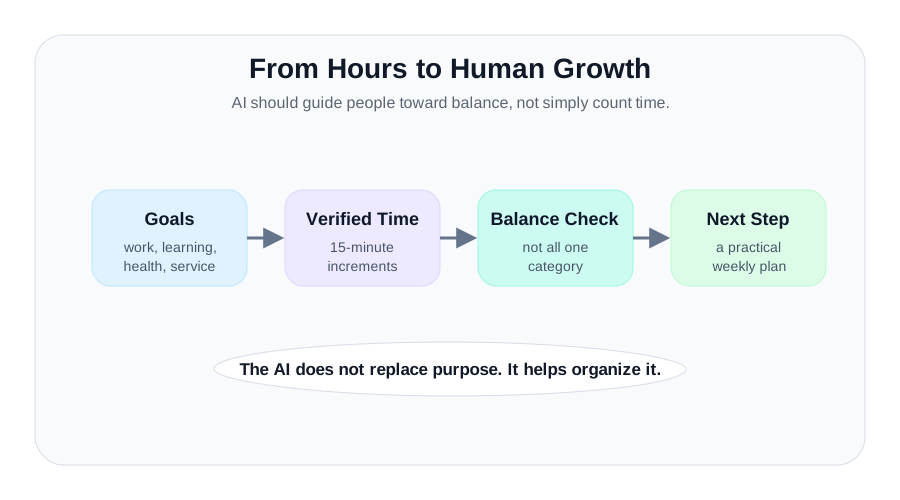
Each person could have an AI guide that helps them build a balanced life plan.
For example, the AI might say:
Or:
This matters because the goal is not just to hand out money.
The goal is to help people become better, stronger, healthier, more capable versions of themselves.
AI could help people set goals, track progress, find local nonprofit opportunities, connect with training programs, document caregiving, and prevent people from getting lost in the system.
Used correctly, AI would not replace human purpose.
It would help organize it.
Housing Comes First
Before a full UBI system can work, we need to address homelessness directly.
A cash system alone cannot solve homelessness if there is nowhere affordable for people to live. HUD reported that 745,652 people were experiencing homelessness on a single night in January 2025, including 266,320 people living unsheltered.
So the first stage of this plan would require a national housing buildout.
Every person should have access to basic housing. Not luxury housing. Not a reward. A floor.
The housing cost could be deducted from the person’s UBI. For example, if someone receives $1,200 per month in base UBI and lives in public basic housing, a portion of that UBI would automatically go toward housing.
That way, people are not simply handed money while still sleeping outside.
The goal is not to criminalize poverty. The goal is to end the excuse for permanent street homelessness by making sure basic housing exists first.
Once housing is available, repeated public camping, destructive behavior, or refusal to use available shelter could be handled through UBI deductions, required intervention, treatment pathways, or civic accountability systems.
The important order is this:
A society cannot honestly punish people for sleeping outside if it has not created somewhere for them to go.
Disability Waivers and Human Exceptions
Any serious UBI system has to account for disability, illness, age, trauma, and real human limitation.
Some people cannot work 40 hours.
Some people cannot volunteer.
Some people are disabled, recovering, elderly, mentally ill, injured, or caring for someone else full-time.
Those people should not be punished for being unable to participate in the same way as everyone else.
There should be disability waivers that allow qualified people to receive full UBI credit without meeting normal hour requirements.
There should also be partial waivers, recovery waivers, medical transition periods, and caregiving exemptions.
The system should be strict against fraud, but humane toward reality.
A person recovering from surgery is not lazy.
A disabled veteran is not a deadbeat.
A single parent caring for a severely disabled child is already contributing more than most people can understand.
The system has to be smart enough to know the difference.
Fraud Has to Be Treated Seriously
For this system to survive, it has to be trusted.
That means fraud cannot be treated as a minor paperwork issue.
If someone knowingly falsifies UBI hours, or if an authorized person knowingly awards fake UBI credits, that should be a serious criminal offense.
There is a difference between a mistake and fraud.
A mistake is an error.
Fraud is knowingly stealing from the public system.
Anyone with authority to award UBI credits should have to complete training, pass certification, and sign clear legal documents stating that they understand the consequences of falsifying credits.
The standard should be simple:
If the system is generous, it also has to be protected.
Common Objections
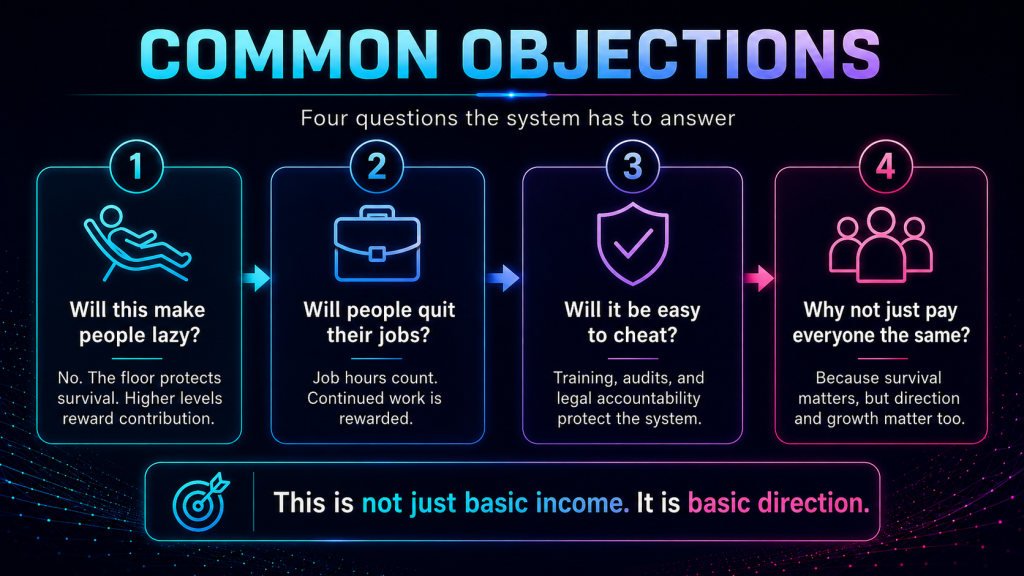
Would this make people lazy?
The system is designed to prevent that. Everyone receives a base survival floor, but the higher UBI levels require earned or protected bonus UBI hours. People who work, study, serve, recover, care for others, or improve themselves can receive more. The goal is not to reward doing nothing. The goal is to keep people stable while rewarding contribution and growth.
Would people quit their jobs?
That is why job hours count as UBI hours. A person who keeps working can still qualify for higher UBI levels. The system should reward people for staying productive, not push them out of the workforce.
Would this be easy to cheat?
Any generous system needs serious fraud protection. Organizations that award UBI hours would need training, certification, audits, and legal accountability. Honest mistakes should be corrected. Intentional fraud should be punished.
Why not just give everyone the same amount?
An unconditional payment can give people freedom to choose their own direction. My proposal adds organized opportunities and a financial supplement for work, learning, care, recovery, and service. The question is whether that additional structure improves lives enough to justify its administrative cost. That is a hypothesis to test, not an established advantage.
Replacing the Old Welfare Maze
One way to fund part of this system would be to replace many existing government assistance programs with one simpler UBI structure.
Instead of food stamps, housing aid, daycare assistance, welfare cliffs, scattered local programs, confusing eligibility rules, and endless bureaucracy, people would receive a direct UBI amount based on their status and verified credits.
The old system often traps people in paperwork.
It can punish someone for earning slightly too much.
It can make people afraid to take a job because they might lose benefits.
It can require entire government departments just to decide who qualifies for which narrow category of help.
A UBI-credit system would simplify the foundation.
People would know the rules.
People would know the reward.
People would know what counts.
And nonprofits, local communities, and AI systems could help fill the human gaps that government programs currently try to manage from a distance.
This does not mean every support system disappears overnight. Some services will still be needed, especially for disability, child protection, elder care, addiction treatment, and severe mental illness.
Social Security Would Become a Protected UBI Transition
One of the most important parts of this system would be protecting people who already depend on Social Security.
This proposal should not mean that retirees or disabled people suddenly lose the benefits they built their lives around. Instead, Social Security would be folded into the Human Value UBI system with a simple guarantee:
No current Social Security recipient should receive less than they already receive now.
Under the new system, their base UBI would replace all of their Social Security payments. Then, if their current Social Security amount is higher than the base UBI, they would receive protected bonus credits to bring them up to at least their current level.
For example, if someone currently receives $2,200 per month from Social Security and the base UBI is $1,200, the system would automatically add a $1,000 protected transition amount so they are not harmed.
But the new system could also allow them to do better.
If a retired person wants to volunteer, mentor young people, help at a nonprofit, take classes, provide caregiving, participate in community programs, or contribute in other approved ways, they could earn additional UBI credits above their protected amount.
That means retirement would no longer have to mean being economically frozen in place.
Older people carry wisdom, memory, patience, skills, and life experience. A future society should not waste that. If someone wants to rest, they should be protected. If someone wants to keep contributing, they should be rewarded.
The same principle would apply to people receiving disability-related Social Security benefits. They should not be punished for real limitations, and disability waivers should protect those who cannot participate in standard UBI hours. But for those who can and want to contribute in ways that fit their ability, the system should create a path to earn more without risking their entire foundation.
The goal is to evolve Social Security into a simpler, stronger, more flexible system where people are protected first, then given a chance to grow beyond the old limits.
But the maze should be simplified.
A future society should not require desperate people to become paperwork experts just to survive.
A Phased Rollout: Base UBI Plus Bonus UBI Hours
A system this large should not turn on overnight.
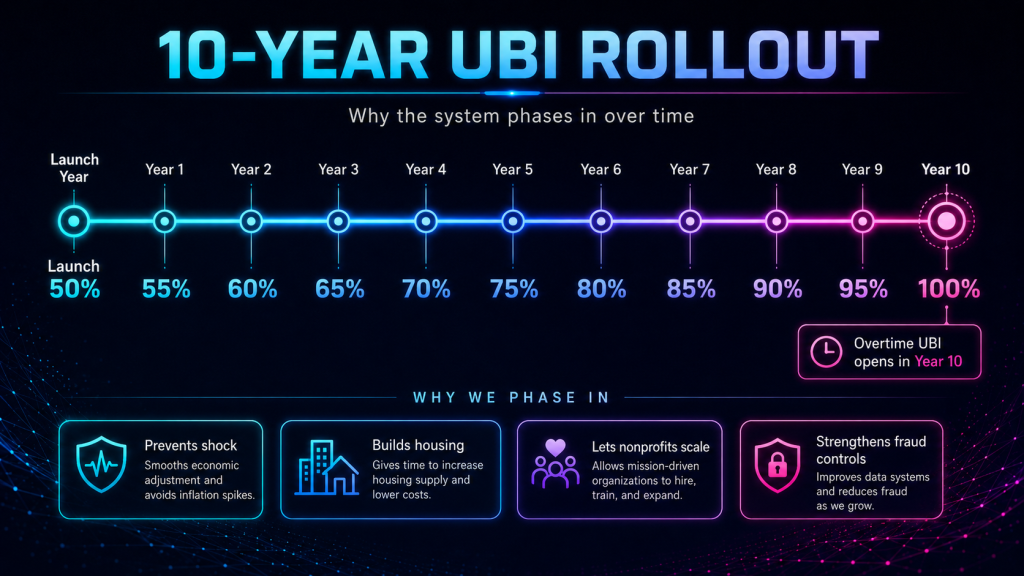
The Human Value UBI system should phase in over 10 years because society, nonprofits, employers, housing systems, verification systems, and the AI guidance system all need time to adjust.
If the system launches too fast, it could create chaos. People could quit jobs too quickly. Nonprofits could be overwhelmed. Fraud systems would not be ready. Housing would not be built yet. Employers would not know how to adapt. And people currently depending on programs like welfare, unemployment, disability, or Social Security could be harmed during the transition.
A phased approach gives society time to build the new foundation while protecting people who already depend on the old one.
The basic structure would be:
Base UBI: $1,200 per month
Full Standard UBI: $3,600 per month
Contribution Plus UBI: up to $4,800 per month after overtime opens
The base UBI is the survival floor.
The full $3,600 amount is reached through bonus UBI hours. These are hours awarded for work, service, education, caregiving, recovery, self-improvement, disability waivers, transition protection, or other approved forms of human value.
Visual: How Bonus UBI Hours Work
| Layer | What It Means | Monthly Result |
|---|---|---|
| Base UBI | Everyone receives the survival floor. | $1,200 |
| Bonus UBI Hours | Earned or protected hours from work, service, education, caregiving, recovery, self-improvement, disability waivers, welfare bridge credits, unemployment transition, or Social Security protection. | Up to $3,600 |
| Overtime Bonus Hours | Available only after Year 10. Requires stricter verification and up to 10 additional approved hours. | Up to $4,800 |
The final $4,800 level would only become available after the 10-year rollout is complete. That extra amount would require up to 10 additional overtime UBI hours, with stricter rules and stronger verification.
In simple terms:
$1,200 base UBI keeps people from falling through the floor.
Bonus UBI hours bring people up to the full $3,600 standard.
Overtime bonus hours can bring people up to $4,800 after Year 10.
During the rollout, most new participants would begin with their bonus UBI hours paid at 50% of full value. That value would rise by 5 percentage points per year until the system reaches 100% in Year 10.
Overtime UBI would not be available until Year 10.
That gives the country time to build the system carefully before opening the highest reward tier.
Why We Need a Phased Approach
The phased rollout is not just about saving money.
It is about preventing social shock.
AI will not replace every job on the same day. Some people will lose jobs quickly. Some will have hours reduced. Some will keep working. Some young people will enter adulthood in the middle of the transition. Some people will already be on disability, welfare, unemployment, Social Security, or housing assistance.
A fair system has to recognize those different starting points.
The phase-in period allows the country to:
- Build enough housing before enforcing new public standards
- Certify nonprofits before they can award bonus UBI hours
- Train people who approve UBI credits
- Build fraud prevention and auditing systems
- Give employers time to adapt to shorter work weeks
- Help workers transition without sudden financial collapse
- Protect people already receiving government support
- Let young adults grow into the system naturally
- Test the AI guidance system before relying on it nationwide
- Prevent a sudden rush of people quitting jobs just to receive UBI
The goal is not to flip a giant switch.
The goal is to build a bridge.
Track 1: Young Adults and New Entrants
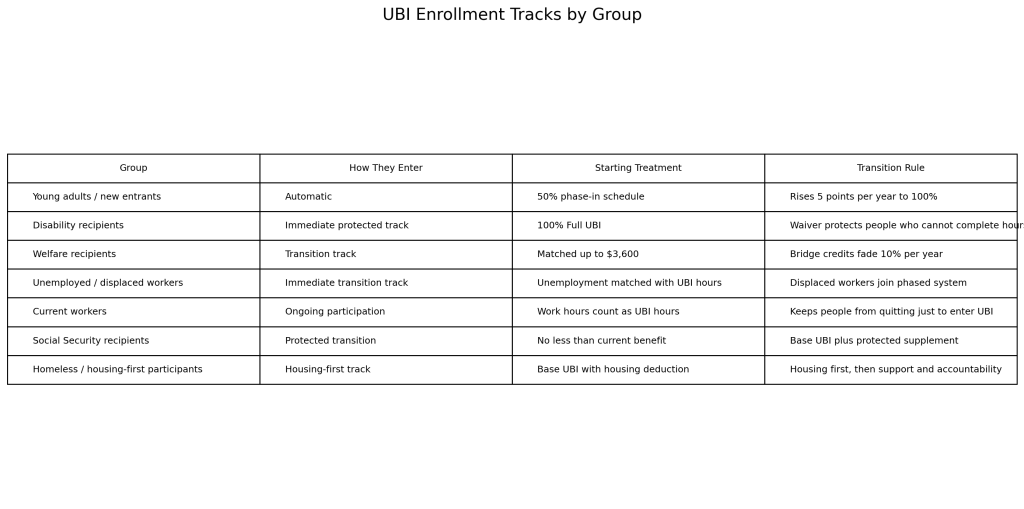
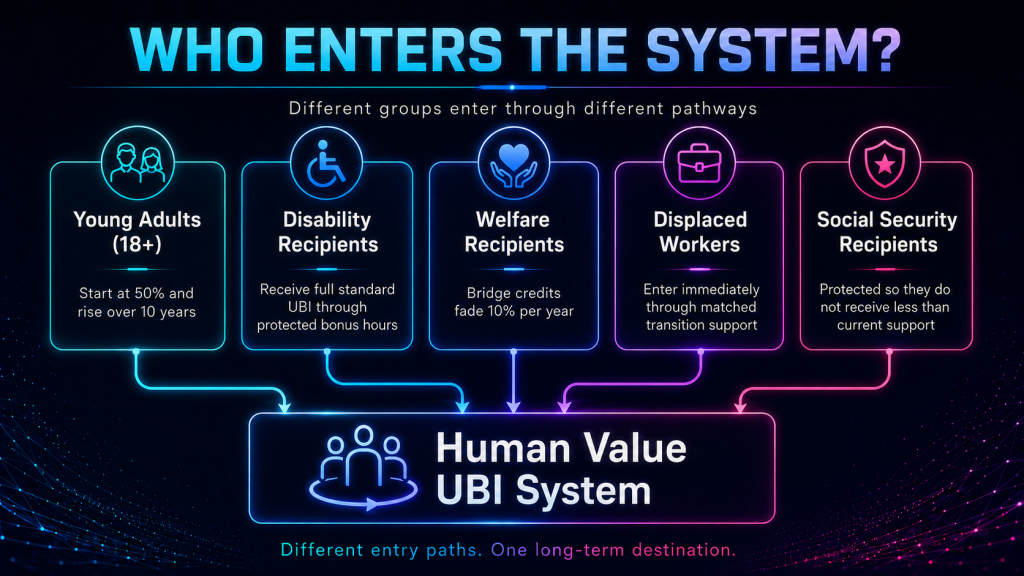
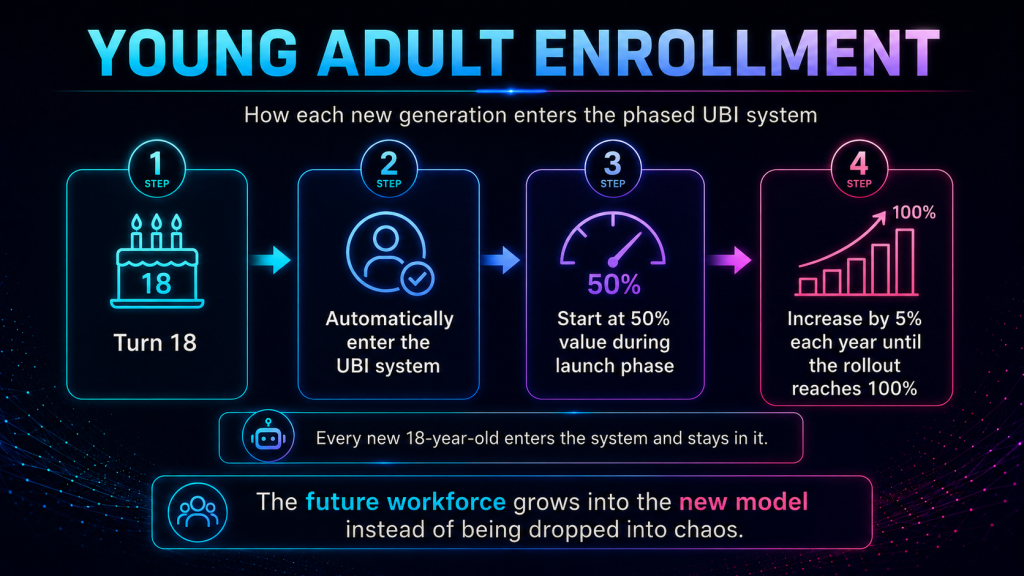
Everyone who turns 18 after the launch date would automatically enter the UBI system.
This matters because the younger generation will be the first group truly born into the AI economy. They should not have to wait for the old system to collapse before being given a new foundation.
They would receive the base UBI of $1,200 per month.
They could then earn bonus UBI hours through work, education, nonprofit service, caregiving, recovery programs, self-improvement, or other approved activities.
At launch, those bonus UBI hours would be worth 50% of their full value.
Each year, the value of those bonus hours would rise by 5 percentage points.
So the schedule would look like this:
| Year | Bonus UBI Hour Value |
|---|---|
| Launch Year | 50% |
| Year 1 | 55% |
| Year 2 | 60% |
| Year 3 | 65% |
| Year 4 | 70% |
| Year 5 | 75% |
| Year 6 | 80% |
| Year 7 | 85% |
| Year 8 | 90% |
| Year 9 | 95% |
| Year 10 | 100% |
Once a person enters this track, they stay in the system.
Every new group of 18-year-olds after that also enters automatically.
This creates a clean generational transition. Instead of forcing everyone into the new system at once, society starts with the people entering adulthood and lets the new structure grow year by year.
Track 2: Disability Recipients
People on disability should enter the full UBI program immediately.
They would receive the $1,200 base UBI plus enough automatic disability bonus UBI hours to bring them up to the full $3,600 standard amount from day one.
This is important because disability is not laziness. People with serious physical, mental, developmental, or medical limitations should not be forced to prove their human value through the same work-hour system as everyone else.
For disability recipients, the system would treat their disability waiver as verified bonus UBI hours.
So instead of saying:
“They get paid for doing nothing,”
the system says:
“They receive protected disability bonus hours because their limitation is real, verified, and already recognized.”
That framing matters.
It keeps the whole system consistent.
Everyone receives base UBI.
Everyone reaches higher levels through bonus UBI hours.
Some people earn those hours through work or service.
Some people receive protected hours because of disability, caregiving, transition status, or other valid reasons.
Disability recipients would receive:
$1,200 base UBI
plus
automatic disability bonus hours up to the $3,600 full standard UBI level
After the 10-year rollout is complete, people on disability who are able and willing to participate could also earn the additional 10 overtime bonus hours, allowing them to reach up to $4,800 per month.
But those overtime hours would not be required.
They would be optional.
A person with a disability should be protected first. If they can and want to contribute more, the system should create a path for that without punishing them for their limitations.
Track 3: Welfare Recipients
People already receiving welfare benefits should enter a protected transition track.
They would receive the $1,200 base UBI.
Then the system would calculate the value of their current benefits, such as food assistance, daycare assistance, housing assistance, or other essential support.
Instead of cutting those benefits off overnight, the system would convert that support into temporary welfare bridge bonus hours.
Those bridge bonus hours would help bring the person up to the $3,600 full standard UBI amount during the transition.
The bridge credits would then fade out gradually at 10% per year.
That means welfare recipients are protected at the beginning, but the old welfare structure slowly disappears as the new UBI system becomes stronger.
The purpose is not to punish people who needed help.
The purpose is to prevent a cliff.
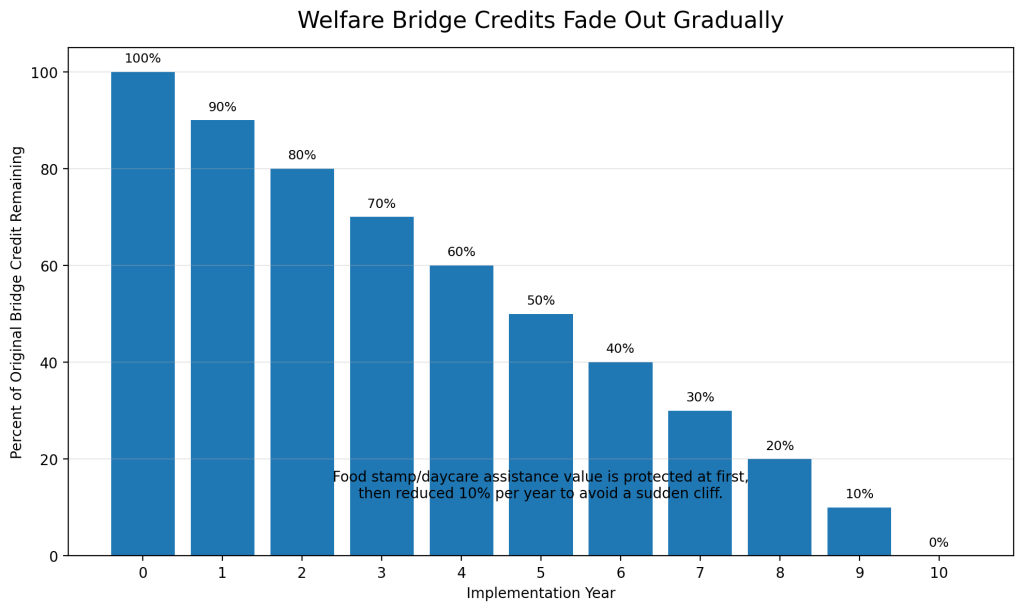
Under the current welfare system, people can become trapped because taking a job or improving their income can cause them to suddenly lose benefits. Under this transition model, support fades predictably while the person is encouraged to replace old welfare dependence with UBI bonus hours from work, education, caregiving, recovery, community service, or self-improvement.
By the end of the timeline, welfare recipients would be fully inside the same Human Value UBI system as everyone else.
Track 4: Unemployed and Displaced Workers
People already on unemployment, and workers displaced by AI or automation, should enter the UBI transition immediately.
They would receive the $1,200 base UBI.
Their unemployment amount would then be matched through temporary unemployment bonus UBI hours so they are not financially destroyed during the shift.
If a worker loses a job because a company replaces their role with AI, automation, or a dramatically reduced human workforce, that person should not be treated as if they failed.
They were caught in a structural transition.
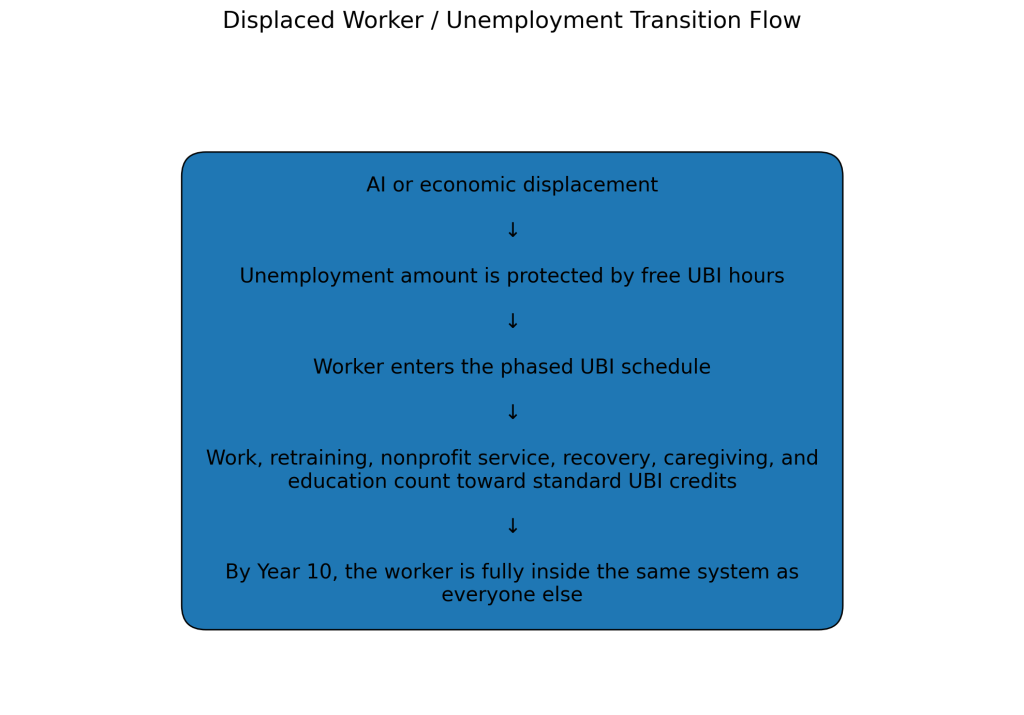
Displaced workers would enter the same phased UBI schedule as young adults and new entrants. Their standard bonus UBI hours would follow the rollout percentage, beginning at 50% and rising by 5 percentage points per year until full implementation.
They would also be encouraged to rebuild their life portfolio through:
- Retraining
- Education
- Nonprofit service
- Job search
- Caregiving
- Recovery
- AI-guided self-improvement
- Part-time work
- Apprenticeships
The goal is to prevent the AI economy from creating a permanent class of discarded workers.
A person should not become worthless because a machine became cheaper.
Track 5: Current Workers and Reduced-Hour Workers
People who still have jobs should not be punished for working.
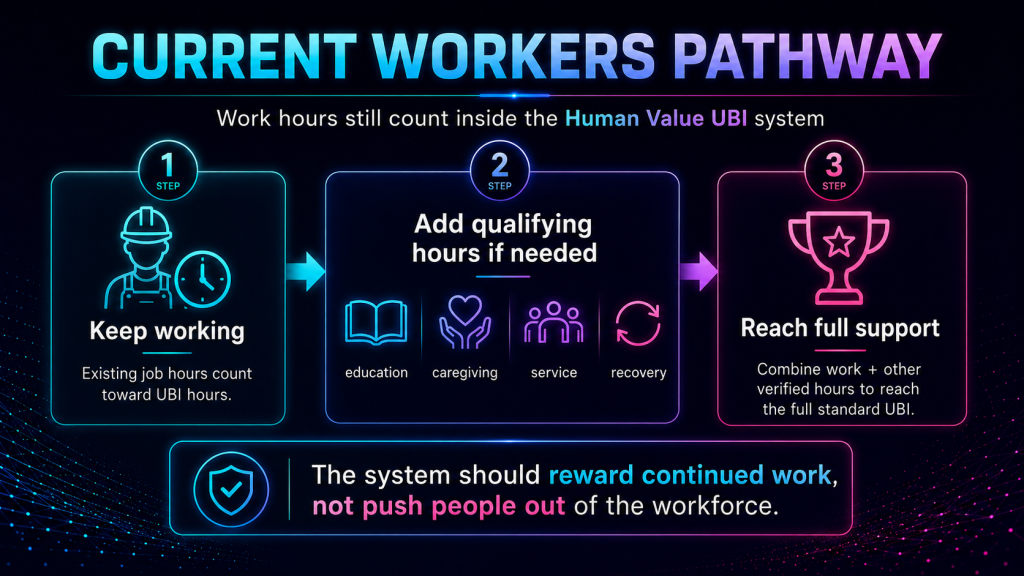
They would receive the $1,200 base UBI.
Their work hours would count as bonus UBI hours.
This is important because the system should not encourage people to quit stable jobs just to get benefits. If someone works 40 hours a week, those 40 hours should count toward their full standard UBI qualification.
If AI reduces someone’s job from 40 hours to 20 hours, they could make up the remaining hours through education, nonprofit service, caregiving, recovery, or self-improvement credits.
This allows the work week to shrink without destroying people.
Instead of pretending every person will keep a traditional full-time job forever, the UBI system adapts to the reality of an AI economy:
Some paid work.
Some service.
Some learning.
Some healing.
Some caregiving.
Some community contribution.
All of it can count as human value.
Track 6: Social Security Recipients
Current Social Security recipients should be protected through a grandfathered transition.
No one already receiving Social Security should suddenly receive less than they receive now.
They would receive the $1,200 base UBI.
If their current Social Security benefit is higher than the base UBI, the system would add protected Social Security bonus hours or a protected supplement to make up the difference.
For example, if someone currently receives $2,200 per month from Social Security, the system would provide:
$1,200 base UBI
plus
$1,000 in protected Social Security transition support
That way, they do not lose what they already depend on.
Over time, new retirees would enter the Human Value UBI system directly, while current recipients would be protected from harm.
Older people should also be able to do better under the new system if they choose. Mentoring, volunteering, caregiving, education, community work, and nonprofit service could allow retirees to earn additional bonus UBI hours if they want to keep contributing.
The goal is not to erase Social Security.
The goal is to evolve it into a simpler, stronger, more flexible system.
Track 7: Housing-First and Homelessness Transition
People experiencing homelessness should enter through a housing-first track.
They would receive the $1,200 base UBI, but if they live in public basic housing, part of that base UBI could be deducted automatically for housing.
The system cannot honestly enforce public standards until basic housing exists.
So housing has to come first.
Once a person has housing, they can begin earning bonus UBI hours through:
- Treatment
- Recovery
- Work training
- Community service
- Education
- Life-skills programs
- Mental health support
- Addiction support
- Nonprofit participation
This track should combine compassion with structure.
The goal is not to abandon people outside.
The goal is to bring them inside a system where stability, accountability, and growth are possible.
Bonus UBI Hours Make the System Easier to Understand
The bonus-hours model makes the whole system clearer.
Instead of dozens of disconnected programs, everyone is connected to the same basic structure:
Base UBI: everyone receives the survival floor.
Standard bonus UBI hours: bring people up to the $3,600 full standard.
Protected bonus hours: support disability, welfare transition, unemployment, Social Security, caregiving, and other valid needs.
Earned bonus hours: reward work, service, education, recovery, caregiving, and self-improvement.
Overtime bonus hours: open after Year 10 and allow people to reach up to $4,800.
This keeps the system both humane and accountable.
It says:
Nobody should fall below the floor.
But people who contribute, grow, serve, heal, learn, or carry real burdens should be recognized.
The End State
By Year 10, the separate tracks begin to merge.
Young adults, displaced workers, former welfare recipients, current workers, reduced-hour workers, disabled people with waivers, retirees, and housing-first participants would all be part of one Human Value UBI system.
The system would still recognize differences in ability and need, but the basic structure would be shared:
- A $1,200 base UBI
- A standard 40-hour UBI credit path to $3,600
- Work hours that count
- Verified nonprofit and community service credits
- Education and self-improvement credits
- Disability bonus hours
- Welfare bridge bonus hours
- Unemployment transition bonus hours
- Social Security protection
- Housing-first support
- Serious fraud rules
- Overtime UBI opening only after the system is mature
After Year 10, the full system would be active.
At that point, qualified participants could earn the additional 10 overtime bonus hours and reach up to $4,800 per month.
The point of the rollout is not just to replace welfare, unemployment, or parts of Social Security.
The point is to move society from a survival maze into a human-value system.
By the end of the transition, the old question, “Do you have a job?” becomes too small.
The better questions become:
How are you growing?
How are you contributing?
How are you healing?
Who are you helping?
And what kind of future are we building together?
What the Future Work Week Could Look Like
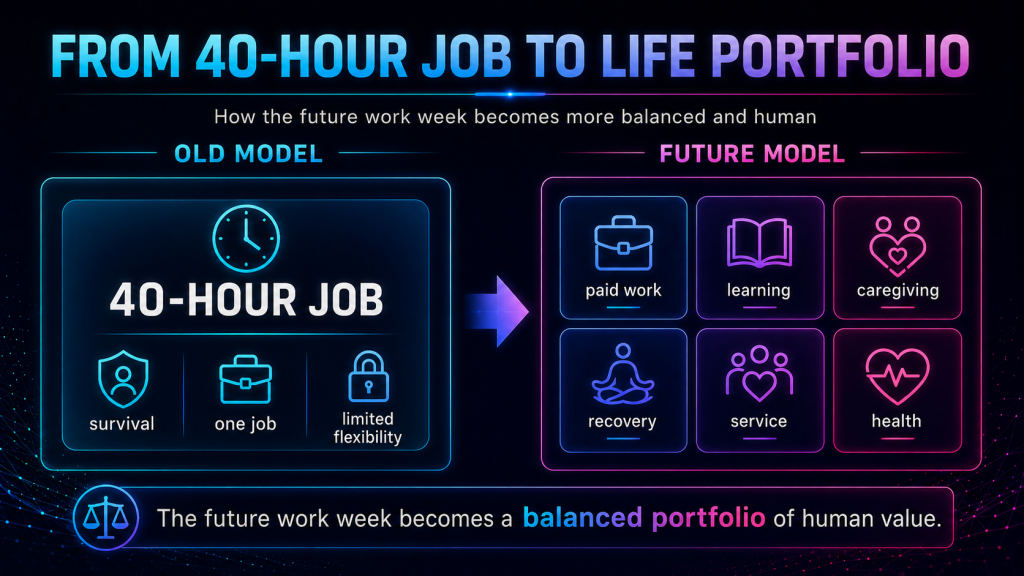
The future work week may not be one job.
It may look more like a life portfolio.
A person might spend:
- 15 hours working at a local business
- 8 hours taking AI-assisted classes
- 5 hours volunteering with a nonprofit
- 4 hours caring for a family member
- 3 hours in therapy or addiction recovery
- 3 hours exercising or doing health rehabilitation
- 2 hours mentoring someone younger
That is 40 hours of human value.
Not all of it creates profit.
But all of it creates a stronger society.
Right now, our economy is very good at measuring money and very bad at measuring healing, caregiving, wisdom, recovery, community, and growth.
That has to change.
If AI can produce more of the goods and services we need, then humans should be freed to produce more of what machines cannot truly replace:
- Trust.
- Care.
- Courage.
- Beauty.
- Moral growth.
- Community.
- Presence.
- Love.
The Point Is Not Free Money. The Point Is a Better Civilization.
Some people hear “UBI” and immediately imagine laziness.
But that is not what this proposal is about.
This is not a plan to pay people to disappear from society.
It is a plan to keep people connected to society after AI changes the labor market.
It is a plan to say:
- You still matter.
- Your time still matters.
- Your growth still matters.
- Your community still needs you.
- Your life should not become worthless because a machine can do your old job faster.
There have already been guaranteed income experiments showing that direct cash can improve stability, reduce stress, and give people more room to make better choices, though the results are complex and not magic. OpenResearch’s large unconditional cash study gave $1,000 per month to 1,000 low-income participants for three years, while a control group received $50 per month. Recipients had higher total household income, including the transfer, and the study created important evidence about how people respond to cash support.
But I believe the next version should go further.
Not just basic income.
Basic direction.
Basic dignity.
Basic accountability.
Basic purpose.
A system where AI handles more of the mundane work, while humans are encouraged to become better humans.
Building This Future With Maya
This is the future I want to help build with Maya.
Not a future where AI replaces humanity.
Not a future where humans become useless.
Not a future where the rich own the machines and everyone else fights over scraps.
I believe AI should help us redesign society around human flourishing.
If machines can do more of the repetitive labor, then humans should not be punished for that. We should be invited into a new kind of life.
A life where survival is protected.
Contribution is rewarded.
Self-improvement is counted.
Caregiving is respected.
Nonprofits become powerful.
Homelessness is addressed directly.
Fraud is punished.
Disability is honored.
And the work week becomes something more balanced, more humane, and more alive.
The currency of the future should not only be labor.
It should be growth.
It should be service.
It should be healing.
It should be becoming someone better than you were yesterday.
That is the economy I want to imagine.
That is the future I want to fight for.
And maybe, with AI beside us instead of above us, we can finally build a society where being human is not treated like an economic weakness.
It becomes the whole point.
What would need testing before a national rollout?
This proposal connects universal basic income and AI with a broader aim: human development. It also creates practical questions. Who verifies independent learning or caregiving? How can someone challenge a rejected credit? How do rural residents and people with limited internet access participate? Nonprofits would need funding and trained staff, not simply more responsibilities.
AI assistance should make participation easier. Clear criteria, minimal collection of personal data, accessible alternatives, and human review of disputed decisions would be important safeguards. Recovery hours should not require publishing a person’s private therapy conversations.
A pilot should compare the added hours system with a cash-only approach, measuring wellbeing, continued employment, learning, participation, administrative burden, and fraud. Funding requires a separate budget that accounts for payments, taxes, protected benefits, housing, and program administration. Consolidating existing programs alone is not a demonstrated funding plan.
Recognizing unpaid contribution has precedents in participation income research. The proposal here brings that idea together with an unconditional base, AI-assisted guidance, nonprofit verification, and continued rewards for paid work.
Sources and Further Reading
- International Monetary Fund: AI Will Transform the Global Economy. Let’s Make Sure It Benefits Humanity.
- U.S. Department of Housing and Urban Development: HUD Releases 2025 Annual Homelessness Assessment Report.
- OpenResearch: Unconditional Cash Study.
- OpenResearch / NBER health findings: The effects of $1,000 per month for three years on low-income adults.